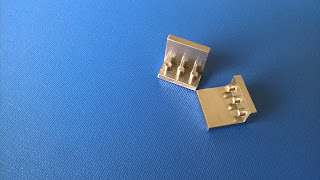
Renohopmt share with you Automatic Fixture
Design
China precision machining Traditional synchronous grippers for assembly equipment move parts
to the gripper centre-line, assuring that the parts will be in a known position
after they arc picked from a conveyor or nest. However, in some applications,
forcing the part to the centre-line may damage cither the part or equipment.
When the part is delicate and a small collision can result in scrap, when its
location is fixed by a machine spindle or mould, or when tolerances are tight,
it is preferable to make a gripper comply with the position of the part, rather
than the other way around. For these tasks, Zaytran Inc. Of Elyria, Ohio, has
created the GPN series of non- synchronous, compliant grippers. Because the
force and synchronizations systems of the grippers are independent, the synchronization
system can be replaced by a precision slide system without affecting gripper
force. Gripper sizes range from 51b gripping force and 0.2 in. stroke to 40Glb
gripping force and 6in stroke.
China precision machining Grippers Production is characterized by batch-size becoming smaller
and smaller and greater variety of products. Assembly, being the last
production step, is particularly vulnerable to changes in schedules,
batch-sizes, and product design. This situation is forcing many companies to
put more effort into extensive rationalization and automation of assembly
that was
previouslyextensive rationalization and automation of assembly that was
previously the case. Although the development of flexible fixtures fell quickly
behind the development of flexible handling systems such as industrial robots,
there are, nonetheless promising attempts to increase the flexibility of
fixtures. The fact that fixtures are the essential product - specific
investment of a production system intensifies the economic necessity to make
the fixture system more flexible.
China precision machining Fixtures can be divided
according to their flexibility into special fixtures, group fixtures, modular
fixtures and highly flexible fixtures. Flexible fixtures are characterized by
their high adaptability to different workpieces, and by low change-over time
and expenditure.
There are several steps required to generate a fixture, in which a
workpiece is fixed for a production task. The first step is to define the
necessary position of the workpiece in the fixture, based on the unmachined or
base pan, and the working features. Following this, a combination of stability
planes must be selected. These stability planes constitute the fixture
configuration in which the workpiece is fixed in the defined position, all the
forces or torques are compensated,
and the necessary access to the working
features is ensured. Finally, the necessary positions of moveable or modular
fixture elements must be calculated- adjusted, or assembled, so that the
workpiece is firmly fixed in the fixture. Through such a procedure the planning
and documentation of the configuration and assembly of fixture can be
automated.
The configuration task is to generate a combination of stability planes,
such that fixture forces in these planes will result in workpiece and fixture
stability. This task can be accomplished conventionally, interactively or in a
nearly fully automated manner. The advantages of an interactive or automated
configuration determination are a systematic fixture design process, a
reduction of necessary designers, a shortening of lead time and better match to
the working conditions. In short, a significant enhancement of fixture
productivity and economy can be achieved China precision machining.