2015年3月5日星期四

True centrifugal casting

True centrifugal casting  
 This is normally China CNC machining used for the making of hollow pipes, tubes, hollow bushes, etc., which are axisymmetric with a concentric hole. Since the metal is always pushed outward because of the centrifugal force, no core needs to be used for making the concentric hole. The axis of rotation can be either horizontal, vertical or any angle in between. Very long pipes are normally cast with horizontal axis, whereas short pieces are more conveniently cast with a vertical axis.   
    
 China precision machining

                              
 A normal centrifugal casting machine used for making cast iron pipes in sand mould is shown in Fig. 11.12. First, the moulding flask is properly rammed with sand to confirm to the outer contour of the pipe to be made. Any end details, such as spigot ends, or flanged ends are obtained with the help of dry sand cores located in the ends. Then the flask is dynamically balanced so as to reduce the occurrence of undesirable vibrations during the casting process. The finished flask in mounted in between the rollers and the mould is rotated slowly. Now the molten metal poured determines the thickness of the pipe to be cast. China CNC machiningAfter the pouring is complete, the mould is rotated at its operational speed till it solidifies, to form the requisite bubing. Then the mould is replaced by a new mould machine and the process continued.    
   Metal mould can also be used in the true centrifugal casting process for large quantity production. A water jacket is provided around the mould for cooling it. The casting machine is mounted on wheels with the pouring ladle, which has a long spout extending till the other end of the pipe to be made. To start, the mould is rotated with the metal being delivered at the extreme end of the pipe. The casting machine is slowly moved down the track allowing the metal to be deposited all along the length of the pipe. 
  The machine is China CNC machining continuously rotated till the pipe is completely solidified. Afterwards, the pipe is extracted from the mould and the cycle repeated.      

2015年3月3日星期二

Centrifugal Casting


Centrifugal Casting
   China metal parts machining Centrifugal casting consists of having sand, metal, or ceramic mold that is rotated at high speeds. When the molten metal is poured into the mold it is thrown against the mold wall, where it remains until it cools and solidifies. The process is being increasingly used for such products as cast-iron pipes, cylinder liners, gun barrels, pressure vessels, brake drums gears, and flywheels. The metals used include almost all castable alloys. Because of the relatively fast cooling time, centrifugal castings have a fine gram size. There is a tendency for the lighter non-metallic inclusions slagparticles, and dross to segregate toward the inner radius of the casting where it can be easily removed by machining. Due to the high purity of the outer skin, centrifugally cast pipes have a high resistance to atmospheric corrosion. 
  The principle of centrifugal casting is shown as Fig. 11.11. The centrifugal force produced by rotation is large compared with normal hydrostatic forces and is utilized in two ways. The first of these is seen in pouring, where the force can be used to distribute liquid metal over the outer surfaces of a mould. This provides a means of forming hollow cylinders and other annular shapes. The second is the development of high pressure in the casting during freezing. This, in conjunction with directional solidification, assists feeding and accelerates the separation of non-metallic inclusions and precipitated gases. The advantages of the process are therefore twofold: suitability for casting cylindrical forms and high metallurgical quality of the product. 
   The casting  China metal parts machining of a plain pipe or tube is accomplished by rotation of a mould about its own axis, the bore shape being produced by centrifugal force alone and the wall thickness determined by the volume of metal introduced. This practice is widely referred to as true centrifugal casting. In
the case of a component of varying internal diameter or irregular wall thickness a central core may be used to form the internal contours, feeder heads then being introduced to compensate for solidification shrinkage. A further step away from the original concept is the spacing of separate shaped castings about a central down-runner, which forms the axis of rotation. These variations are referred to respectively as semicentrifugal casting and centrifuging or pressure casting; in both cases, since the castings are shaped wholly by the mould and cores, centrifugal force is used primarily as a source of pressure for feeding.

 China CNC machining

The rotational axis may be horizontal, vertical or inclined and important variations exist in respect of mould material and the method of introduction of the molten metal.
    The centrifugal force acting upon a rotating body is proportional to the radius of rotation and to the square of the velocity:               
 China CNC machining

    
The gravitational force on the same mass would be given by:

 China CNC machining

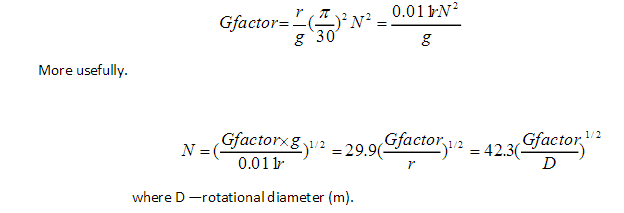
Hence the factor by which the normal force of gravity is multiplied during rotation is given by:
 China CNC machining

Expressed in the more convenient speed units of revolutions per minute, N, the expression becomes:
 china machining manufacturer

  Although centrifugal forces exceeding 200G are attained in some cases, most practice is empirically based within the range 10-150G, the highest values being used for open bore cylindrical components of small diameter and the lowest for semicentrifugal and pressure castings. Speeds generating forces of 60-80G are most commonly quoted for true centrifugal castings. As previously emphasized, however, the optimum value of centrifugal force diminishes with increasing diameter.    
    Cumberland quotes values of 33G for a wide range of plain vertical axis castings and 15G for semi-centrifugal castings in sand moulds, for which lower speeds suffice since there is no longer dependence on centrifugal force to shape the casting. Thornton gives values of 50-100G for die cast and 25-50G for sand castpots and shaped castings.     

    This is a process where the mould is rotated rapidly about its central axis as the metal is poured into it. Because of the centrifugal force, a continuous pressure will be acting on the metal as it solidifies. The slag, oxides and other inclusions being lighter, get separated from the metal and segregates toward the centre.  China metal parts machining There are three main types of centrifugal casting processes. They are: true centrifugal casting, semi-centrifugal casting, centrifuging.      

2015年3月1日星期日

Vacuum Casting and Continuous Casting

Vacuum Casting and Continuous Casting
 Vacuum Casting
 Vacuum casting is similar China CNC machining to Low Pressure Die Casting in that a permanent mould is linkedto a crucible of molten metal by a riser tube, but instead of pressure being applied to themolten metal, a vacuum is created in the mould cavity, thus drawing the metal up into the cavity.
 Continuous Casting
  Generally the starting point of any structural steel product is the ingot which is subsequently rolled through number of mills before a final product. However, the wide adoption of continuous casting has changed that scenario by directly casting slabs,billets and blooms without going through the rolling process. This process is fast and also economical.
   Continuous casting is the process whereby molten steel is solidified into a semifinished billets, blooms, China CNC machining or slabs for subsequent rolling in finishing mills.
In continuous casting, liquid steel is transferred in a ladle to the casting machine. When the casting operation starts, the sliding shutter at the bottom of the ladle is opened and the steel flows at a controlled rate into the tundish and from the tundish into one or more molds The liquid steel is poured into a double walled, bottomless water cooled mould where a solid skin is quickly formed and a semi-finished skin energy form the open mould bottom. The skin formed in the mould is about 10 to 25 mm in thickness and is further solidified by intensive cooling with water spays as casting moves downwards. About 55 percent of the world's liquid steel production is solidified in continuous casting processes, the most widely used of which feeds liquid steel continuously into a short, water-cooled vertical copper mold and, at the same time, continuously withdraws the frozen shell, including the liquid steel it contains. 
                Fig. 11.9 Schematic of continuous casting process   

 China precision machining

 A typical arrangement of continuous casting plant is shown schematically in Fig. 11.9. The molten steel is collected in a ladle and kept over a refractory lined intermediate pouring vessel named tundish. The steel is taken poured into water cooled vertical cooper moulds which are 450 to 750 mm long. Before starting the casting a dummy starter bar is kept in the moulds bottom as shown in Fig.11.9. After starting the casting process as the metal level rises in the mould to a desirable height, the starter bar is withdrawn at a rate equal to the steel pouring rate. The initial metal freezes onto the starter bar as well as the periphery of the mould. This solidified shell supports the liquid steel as it moves downwards. This steel shell is mechanically supported (rollers) as it moves down through the secondary cooling zone where water is spried onto the shell surface to complete the solidification process. After the casting is completely solidified, it is cut to the desired lengths by a suitable cutoff apparatus.
  To appreciate fully the substantial benefits of continuous casting it is necessary to review some aspects of modern steelmaking and the older process of ingot casting. 
 In both processes, molten steel (usually called a “heat”) is prepared or an electric furnace. The in an oxygen furnace, an open-hearth furnace molten steel is next transferred in a ladle to either a nearby ingot or continuous casting facility. 

 Various types of ingots are prepared, in both processes, depending on the size and shape of the final steel products to be manufactured. China CNC machiningThree types of ingots are made: billets, blooms and slabs. Slabs are used to make plate and other flat products. Billets and blooms are used to make structural shapes, round products and tubes.  

2015年2月26日星期四

Ceramic Mold Casting

Ceramic Mold Casting
Similar to plaster mold casting, China precision machining the pattern used in ceramic mold casting is made of plaster, plastic, wood, metal or rubber. A slurry of ceramic is poured over the pattern. It hardens rapidly to the consistency of rubber. This can be peeled of the pattern, reassembled as a mold. The volatiles are removed using a flame torch or in a low temperature oven. It is then baked in a furnace at about 1000 °C (1832 °F) yielding a ceramic mold, capable of high temperature pours. Additionally, the pour can take place while the mold is until hot.
Tolerances can be held to 0.4 %, surface finishes can be better than 2 - 4 μm (.075 - .15 μin). Add 0.3 mm (.012 in) for parting line tolerances. Wall thickness can be as small as 1.25 mm (.050 in), and the weights can range from 60 g (2oz) to a ton. Draft allowance of 1° is recommended.
This process is expensive, but can eliminate secondary machining operations. Typical parts made from this process include impellers made from stainless steel, bronze, complex cutting tools, plastic mold tooling.
Procedure:
Models made of clay, wood or plaster must be coated with 2 or 3 layers of thinned down orange shellac.
Step 1: First you must study the object from which you are to make the mold, to establish the Parting Line. Draw a line on the object with a dye-marking felt tip pen.
Step 2: Place the object on your Work Board so your parting line is somewhat parallel to your work surface. Proceed to Clay-Up with water base modeling clay around the object to your parting line, extend out for one inch from the widest points.
Step 3: When clay is all in place, smooth and leather hard, square off clay as shown. Using a soft brush, apply two thin coats of Orange Shellac over the object and the top surface of the clay parting line. After 15-20 minutes, apply talcum powder, dusting lightly.
Step 4: Apply Parting Agent with a soft brush covering the entire surface. Dry your brush and pick up all excess Parting Agent, leaving a very slick surface on the object and parting line clay.
China precision machining
Step 5: Prepare your casting boards, wiping each with Parting Agent on front surface and edges. Assemble as shown with "C" Clamps. With wooden tool, seal edges where clay parting line meets the insides of the board as shown.
Step 6: READY FOR CASTING. For the size of the object shown in these drawings and the apparent bulk of parting line around the model, we will use the following proportions: With your 1 gallon plastic jar, weigh out 1 1/2 lbs. of No.1 Pottery Plaster
Step 7: Let the plaster soak for 3-5 minutes, then mix with your Drill Motor Mixer. Mix for about 1 1/2 minutes, then pour over boxed pattern. Plaster should cover at least 1 inch over the highest point on the Model.
Step 8: After 20 minutes, take casting boards apart, scrape off top of plaster and bevel the edges slightly. Grasp opposite sides of the plaster/clay mold and gently twist to loosen clay from the work board as shown. Turn mold over and proceed to lift off clay from model and plaster half of the mold.
China precision machining
Step 9: If orange shellac transfers to plaster half, clean with alcohol. Clean all clay particles from the mold surface. Now is the time to carve Keys into the plaster parting line. You can make Keys several ways - round end of large spatula, a coin (nickel or quarter).
Step 10: Prepare your casting boards again, dust the model and parting line area with talcum, brush on parting agent as in Step 4. Assemble the boards as in Step 5 with "C" Clamps and repeat Steps 6 and 7 for casting the second half of the mold. Let the plaster set for 1/2 hour, remove the casting boards, scrape top of the mold, bevel the edge and corners.
Step 11: Now you are ready to open the mold. Scrape off any plaster that may have run down the side of the first half of the mold. Using a flat end screwdriver or a wooden wedge, insert it at the parting line; tap it gently with the hammer. As soon as the mold starts to part, turn the mold over and repeat the process. When the mold is loose, grasp each half and gently pry apart.
Step 12: The model will usually stay in half of the mold. At this point, how accurate you were with your parting line, what material your model was made of , and how hard or soft that material was, will dictate how easy or hard it will be to get the model out of the half plaster mold.
China precision machining
Step 13: If the model was made of clay, you can ease it out by using the screwdriver. But if you have to do any prying like a lever, place a flat piece of wood under your screwdriver so you won't chip the plaster mold. If your model is made of metal, glass or ceramic, you might have to use other means, such as air pressure or tapping all around the model with a rubber mallet. In some cases, you have chipped out the model thus destroying it. But keep in mind, that at this point the mold is the main object because a good, China precision machining usable mold can reproduce 50 to 150 objects.
Step 14: With both halves now clean of any particles, we now determine where to carve in your Pour Hole. It can be in one half or in both halves as shown. Bevel the outer edge of the parting line on both halves and bevel all outside edges of the mold. This keeps that edge from chipping.
China precision machining
Step 15: At this time, China precision machining check each half of the mold for any under-cuts that can be cut back. Let your mold dry out for 4 or 5 days depending on your weather conditions. NOW YOU HAVE A MOLD.

2015年2月24日星期二

Squeeze Casting and Lost Foam Casting

Squeeze Casting and Lost Foam Casting
     Squeeze China precision machining casting also known as liquid metal forging, is a combination of casting and forging process  The molten metal is poured into the bottom half of the pre-heated die. As the metal starts solidifying, the upper half closes the die and applies pressure during the solidification process. The amount of pressure thus applied is significantly less than used in forging, and parts of great detail can be produced.

 Coring can be used with this process to form holes and recesses. The porosity is low and the mechanical properties are improved. Both ferrous and non-ferrous materials can be produced using this method.              
 Fig. 6.12 Schematic of squeeze casting process  
 China precision machining

 Lost Foam Casting
    Lost foam casting allows the production of complex parts. The process produces complex parts and reduces finish machining of the part produced by lost foam casting.
  To make lost foam casting, a foam pattern of the finished part is made.
  The pattern is dipped into a water solution containing a suspended refractory.  The refractory material coats the foam pattern leaving a thin heat resistant layer. Sand is poured around the pattern and provides mechanical support to the thin refractory layer. 。  Molten metal is then poured into the mold, and the molten metal melts and vaporizes the foam. When the metal becomes solid, it is removed from the sand, thus the name lost foam casting.   Lost foam castings may be of any shape or size. Materials commonly used in lost foam casting are Aluminum, iron, steel and nickel alloys.  The Lost Foam casting process originated in 1958 when H.F. Shroyer was granted a patent for a cavity-less casting method,China precision machining using a polystyrene foam pattern embedded in traditional green sand. 
   The polystyrene foam pattern left in the sand is decomposed by the poured molten metal.  The metal replaces the foam pattern, exactly duplicating all of the features of the original pattern.   Like other investment casting methods, this requires that a pattern be produced for every casting poured because it is evaporated (“lost”) in the process.    
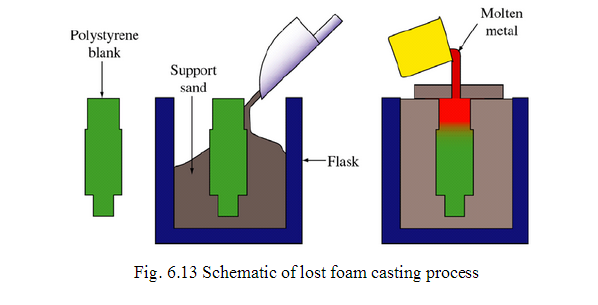
The basic steps to the process include (Fig. 6.13):
 1. A foam pattern and gating system are made using a foam molding press 
2. The foam pattern and the gating system are glued together to form a cluster of patterns
 3. The cluster is coated with a permeable refractory coating and dried under controlled conditions 
4. The dried, coated cluster is invested in a foundry flask with loose, unbonded sand that is vibrated to provide tight compaction 
5. The molten metal is poured on to the top of the gating system which directs the metal throughout the cluster and replaces the foam gating and patterns
6. The remaining operations such as, shake out, cut-off,
grinding, heat treat, etc. are straightforward and similar to other casting processes.   
Fig. 6.13 Schematic of lost foam casting process       
 China precision machining


Generally, all ferrous and non-ferrous materials can be successfully cast using the Lost Foam process.  Because the foam pattern and gating system must be decomposed to produce a casting, metal pouring temperatures above 1000°F are usually required. Lower temperature metals can be poured, but part size is limited. China precision machining In addition, very low carbon ferrous castings will require special processing.  

2015年2月22日星期日

Investment Casting

 Investment Casting
 This is the process where the mould is China precision machining  prepared around an expendable pattern. Casting processes in which the pattern is used only once are variously referred to as "lost-wax" or "precision-casting" processes. In any case they involve making a pattern of the desired form out of wax or plastics (usually polystyrene).
 The first step in this process is the China precision machining   preparation of pattern for every casting made. To do this, molten wax which is used as the pattern material is injected under pressure of about 2.5 MPa into a metallic die which has the cavity of the casting to be made.
  The wax when allowed to solidify would produce the pattern. To this wax pattern, gates, runners and any other details required are appended by applying heat. 
   The process has been described as the lost wax, precision casting, and investment
casting process. The last-dimensional name has been generally accepted to distinguish the present industrial process from artistic, medical, and jewelry applications.
  The basic steps of the investment casting process are as follows  
 1. Production of heat disposable patterns, usually in wax or plastic.
 2. Assembly of these patterns onto a gating system.
3. Investing, or covering the pattern assembly with ceramic to produce a
monolithic mold. 
4. Melting out the pattern assembly to leave a precise mold cavity.
 5. Firing the ceramic mold to remove the last traces of the pattern material, to fire the ceramic andChina precision machining   develop the high temperature bond, and to preheat the mold ready for casting.
6. Casting.
 7. Knock-out, cut off, and finishing. 
 China CNC machining


2015年2月13日星期五

Die Casting

   Die Casting
     Die casting involves the preparation of components by injecting molten metal at high pressures into a metallic die.China CNC machining  Die casting is closely related to permanent mould casting, in that both the processes use reusable metallic dies. In die casting, as the metal is forced in under pressure compared to permanent moulding, it is also called pressure die casting'. Because of the high pressure involved in die casting, any narrow sections, complex shapes and fine surface details can be easily produced.

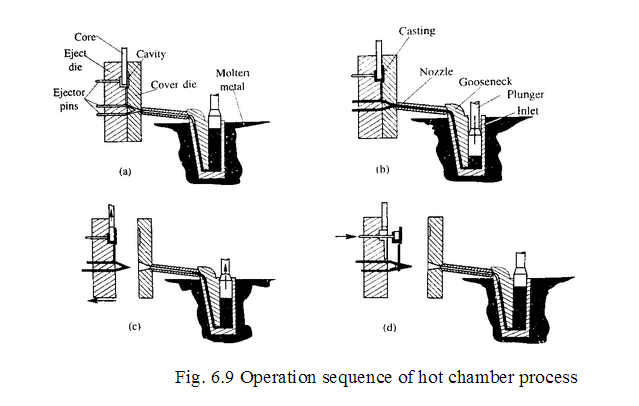
    In die casting, the die consists of two parts. One called the stationary die or cover die which is fixed to the die casting machine. China CNC machining  The second part called the ejector die is moved out for the extraction of the casting. The casting cycle starts when the two parts of the die are apart. The lubricant is sprayed on the die cavity manually or by the auto lubrication system. The two die halves are closed and clamped. The required amount of metal is injected into the die. After the casting is solidified under pressure the die is opened and the casting is ejected.
    The die casting machines are of two types: hot chamber die casting, and cold chamber die casting. The main difference between these two types is that in hot chamber, the holding furnace for the liquid metal is integral with the die casting machine, whereas in the cold chamber machine, China CNC machining the metal is melted in a separate furnace and then poured into the die casting machine with a ladle for each casting cycle which is also called 'shot'.
  Fig. 6.9 Operation sequence of hot chamber process 
 China precision machining